

    Legal Entity Identifier Services hero background

    LEI Registration in Canada — A GLEIF-Accredited LOU for the Canada Financial Market

    Apply for, renew or transfer your Legal Entity Identifier (LEI) for entities registered in Canada. TNV-LEI is a GLEIF-accredited Local Operating Unit, effective 10 October 2025, authorised across 26 approved jurisdictions including Canada. We issue ISO/IEC 17442-compliant 20-character LEI codes under externally audited governance — ISO 9001, ISO/IEC 27001, SOC 2 Type II independent attestation conducted by Ken & Co. (USA), and independent VAPT at annual minimum cadence.

    GLEIF Accredited Badge
    • GLEIF-accredited LOU — effective 10 October 2025; Canada (CA) within accreditation scope

    • Pricing in CAD (C$); GST / HST (federal + provincial) itemised separately on the invoice where applicable

    • ISO 9001-certified QMS; ISO/IEC 27001-certified ISMS

    • SOC 2 Type II independent attestation conducted by Ken & Co. (USA)

    • Independent VAPT — annual cadence minimum

    • Validation against Corporations Canada (federal)

    • Two Executive Directors; three Independent Directors of national standing — including a former Reserve Bank of India Chief General Manager (Department of Regulation) with FATF plenary experience

    Choose the Right Plan For You

    No pricing information available.

    Canada Jurisdiction Overview

    Quick Facts — Canada

    A quick overview of the key regulatory, currency, and business details for the Canada. Use this summary to understand the essentials before exploring the full guide.

    REGULATORY

    CSA, OSC, OSFI, CIRO, Bank of Canada

    CURRENCY

    CAD (C$)

    FieldValue

    Country

    Canada

    ISO 3166 Code

    CA

    Operational Status

    OPEN OFFERING - TNV-LEI authorised for issuance

    Languages

    English, French

    hreflang

    en-CA (primary) + x-default

    Pricing Currency

    CAD (C$)

    Local Tax

    GST / HST (federal + provincial)

    Primary Corporate Registrar

    Corporations Canada (federal); provincial corporate registries including Ontario, Quebec, BC, Alberta and others

    Primary Financial Regulator

    Canadian Securities Administrators (CSA) - provincial coordination; Ontario Securities Commission (OSC) is the largest

    Other Regulators

    Office of the Superintendent of Financial Institutions (OSFI); Canadian Investment Regulatory Organization (CIRO); Bank of Canada

    Principal Exchange

    Toronto Stock Exchange (TSX); TSX Venture Exchange (TSXV); Canadian Securities Exchange (CSE); Neo Exchange

    Clearing / Settlement Infrastructure

    Canadian Depository for Securities (CDS); Canadian Derivatives Clearing Corporation (CDCC)

    Trade Repositories Used

    DTCC Data Repository (Singapore) for OSC Rule 91-507; ICE Trade Vault

    Data Protection Regime

    Personal Information Protection and Electronic Documents Act (PIPEDA); provincial equivalents including Quebec Law 25, BC PIPA and Alberta PIPA

    Privacy Authority

    Office of the Privacy Commissioner of Canada (OPC); provincial privacy commissioners

    AML Supervisor

    Financial Transactions and Reports Analysis Centre of Canada (FINTRAC)

    Tax Authority

    Canada Revenue Agency (CRA)

    Pension Regulator

    OSFI for federal pension plans; provincial pension regulators, such as FSRA Ontario

    Built for Canadian entities applying, renewing or transferring LEIs through TNV-LEI.

    Apply for LEI
    • Is an LEI mandatory for Canadian entities?

      A Legal Entity Identifier is generally mandatory for Canadian entities that are counterparties to derivative transactions reportable under Canada’s reporting frameworks, that are subject to Canadian Securities Administrators supervisory reporting, that are listed on the Toronto Stock Exchange (TSX), or that are required by a counterparty bank to identify themselves with an LEI.

    • Who issues LEIs in Canada?

      GLEIF-accredited Local Operating Units (LOUs) issue LEIs in Canada. TNV-LEI is a GLEIF-accredited LOU authorised to issue LEIs to Canada-registered legal entities. Verify our status at the GLEIF public list of LEI issuing organisations at gleif.org.

    • How long does an LEI take in Canada?

      Standard LEI issuance for Canadian entities completes within one business day after payment and successful validation against Corporations Canada or the relevant provincial registry. Fast-Track LEI issuance in 2 to 4 UK working hours is available, subject to data completeness, applicant authority and successful validation.

    • How much does an LEI cost in Canada?

      LEI registration with TNV-LEI for Canadian entities is priced in CAD (C$). Multi-year terms, including 3 and 5 years, reduce the average annual cost compared to single-year renewal. GST / HST, where applicable, is itemised separately on the invoice.

    • What happens if my Canada LEI lapses?

      A lapsed LEI may cause derivative trade reports to be rejected at the relevant trade repository, bank-onboarding workflows to pause, and cross-border counterparties to refuse to face the entity. Renewing the LEI restores it to Issued status.

    • Can a foreign entity get an LEI for its Canadian subsidiary?

      Yes. Eligibility is determined by where the entity is registered, not where its parent is registered. A subsidiary registered in Canada is eligible for an LEI from TNV-LEI under our GLEIF accreditation.

    • Can a Canadian entity transfer an existing LEI to TNV-LEI?

      Yes. Under GLEIF policy, transferring an existing LEI from another GLEIF-accredited LOU to TNV-LEI is free of charge. The 20-character LEI code does not change; only the managing LOU changes. Transfers typically complete within seven business days.

    • Does a TNV-LEI Canada LEI work in other jurisdictions?

      Yes. The LEI is a global identifier under ISO/IEC 17442. An LEI issued by TNV-LEI for a Canada-registered entity is recognised in every regulatory regime that uses the LEI worldwide, including the EU, UK, US, Australia, Singapore and others.

    ISO/IEC 17442 Identifier

    What is a Legal Entity Identifier (LEI)?

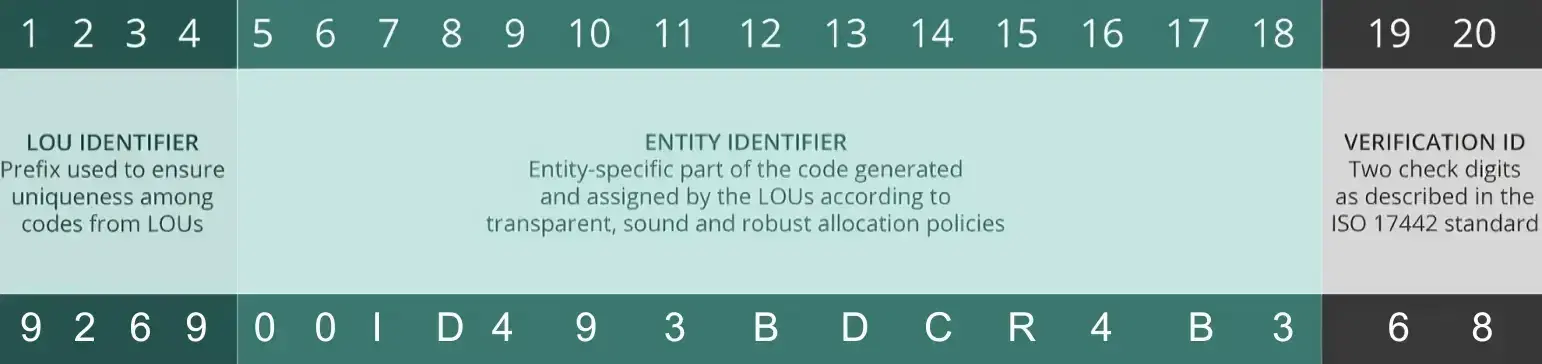
    A Legal Entity Identifier is a 20-character alphanumeric code that uniquely identifies a legal entity participating in financial transactions. In Canada, the LEI appears across CSA derivatives reporting, OSFI prudential reporting, bank onboarding, issuer reference data and cross-border counterparty workflows.

    What is a Legal Entity Identifier (LEI)?

    20 characters

    Format

    Alphanumeric code under ISO/IEC 17442.

    Global

    Scope

    Recognised across financial markets.

    GLEIF

    System

    Published in the GLEIF Global LEI Index.

    Reporting ready

    Canada USE

    Used by CSA, OSC, OSFI, banks and counterparties.

    In short

    It is issued only by GLEIF-accredited Local Operating Units such as TNV-LEI and is used by regulated counterparties, banks, brokers and reporting systems in Canada and globally.

    Regulatory Intelligence

    Country-Specific Regulatory Intelligence — Where the LEI Surfaces in Canada

    This section summarises the statutes, reporting frameworks and supervisory touch points that commonly drive LEI use in Canada.

    Statutes referencing the LEI directly or by reporting linkage

    Statute / RegulationLEI LinkageVerification Source

    Canada Business Corporations Act (CBCA)

    Federal corporations statute; provincial equivalents such as OBCA Ontario and BCBCA British Columbia

    Canadian Securities Administrators (CSA) - provincial coordination

    Bank Act (Canada)

    Governs Schedule I, II and III banks under OSFI supervision

    OSFI / Canadian Securities Administrators

    Insurance Companies Act (Canada)

    Federally regulated insurers under OSFI

    OSFI / Canadian Securities Administrators

    Securities Act (Ontario) and provincial equivalents

    Provincial securities legislation; CSA harmonised rules

    Canadian Securities Administrators

    Proceeds of Crime (Money Laundering) and Terrorist Financing Act (PCMLTFA)

    AML/CTF framework - FINTRAC supervised

    FINTRAC

    Reporting frameworks — LEI obligations in Canada

    FrameworkLEI ProvisionReporting SystemEntities in Scope

    OSC Rule 91-507 and CSA equivalents (Derivatives Trade Reporting)

    LEI required for both counterparties in derivative trade reports

    DTCC; ICE Trade Vault

    OTC derivatives, including IR, FX, equity, credit and commodity

    OSFI Capital Adequacy Returns (CAR) and CCB returns

    LEI references counterparty entities in prudential reporting

    OSFI Regulatory Reporting System

    Federally regulated banks and insurers

    CIRO Universal Market Integrity Rules (UMIR)

    Equity-market integrity reporting; LEI for institutional clients

    CIRO systems

    TSX and TSXV traded equity

    FINTRAC reporting (LCTR, EFT, STR)

    LEI optionally used in entity counterparty identification

    FINTRAC

    AML reporting

    Penalty regime summary

    Canadian securities and prudential enforcement powers can include administrative penalties, supervisory orders and public censure. LEI failure rarely triggers standalone enforcement; more commonly, it cascades into reporting failure under the relevant framework, which is the more direct operational and supervisory risk.

    Global Identity Infrastructure

    Benefits of an LEI for Canadian Entities

    A valid, renewed LEI gives a Canadian entity a verified identifier for reporting, onboarding and cross-border counterparty workflows.

    Trust Signal

    One active LEI gives Canadian reporting systems and counterparties a verified signal to rely on.


    Regulatory readiness

    Supports CSA derivatives reporting, OSFI prudential reporting, CIRO reference data and bank counterparty workflows.

    Bank and broker onboarding

    Helps Canadian banks, brokers and cross-border counterparties identify the legal entity before reportable activity.

    Canada Eligibility Guide

    Why Your Canada Entity Type Needs an LEI

    The reason a Canadian entity needs an LEI is specific to its legal form and activity. Each entity type has its own regulatory trigger, counterparty-driven trigger and consequence of not holding an active LEI.

    Entity type

    Canadian Federal Corporation (Inc., Corp., Ltée)

    The need for an LEI arises when the Canadian Federal Corporation (Inc., Corp., Ltée) engages in reportable financial activity, typically a derivative transaction with a bank, securities issuance, supervisory reporting, or onboarding by a counterparty that requires LEI identification.

    Apply for this LEI
    Eligibility
    Yes — incorporated under CBCA
    Validation source:
    Corporations Canada register
    Evidence required:
    Articles; corporation number; signing authority

    Consequence of LEI absence or lapse:

    counterparties may decline trades; supervisory reporting may be rejected; onboarding may pause until an active LEI is in place.

    Industry Intelligence

    Industry Landing Intelligence — 7 Canada Industry Sub-Sections

    LEI for Canadian CSA-Registered Investment Fund Managers

    CSA-registered investment fund managers require an LEI for OSC Rule 91-507 derivatives trade reporting and for cross-border counterparty identification under EU, UK and US regimes.

    Regulatory trigger: OSC Rule 91-507 and CSA equivalents; cross-border EU EMIR REFIT and CFTC Part 45 expectations

    Operational trigger: Derivative trade reports to DTCC validate LEI at submission.

    TNV-LEI value: ISO/IEC 27001 + SOC 2 Type II by Ken & Co. (USA), a US-recognised attestation standard for Canadian funds with US institutional investors.

    CTA: Investment fund manager LEI

    LEI for Canadian Mutual Funds and ETFs

    Canadian mutual funds and ETFs require an LEI at the fund-trust level for derivative trade reporting and cross-border investor identification, particularly for cross-listed ETFs.

    Regulatory trigger: CSA derivatives reporting rules; cross-border listing requirements

    Operational trigger: Fund-trust LEI identifies the trust as counterparty in derivative trades.

    TNV-LEI value: Bulk handling for fund managers with extensive mutual fund families.

    CTA: Canadian mutual fund LEI

    LEI for OSFI-Supervised Canadian Banks

    Schedule I, II and III banks supervised by OSFI require an LEI for capital-adequacy reporting, cross-border counterparty exchange, and Basel III-aligned reporting.

    Regulatory trigger: Bank Act; OSFI Capital Adequacy Returns; Basel III

    Operational trigger: OSFI Regulatory Reporting System validates LEI at submission.

    TNV-LEI value: Established bank LEI workflow; documented challenge process; UK office providing North-Atlantic time-zone coverage.

    CTA: Canadian bank LEI

    LEI for OSFI-Supervised Canadian Insurance Companies

    Federally regulated Canadian insurers require an LEI for OSFI reporting and for cross-border reinsurance counterparty identification.

    Regulatory trigger: Insurance Companies Act; OSFI Capital Adequacy LICAT/MCT

    Operational trigger: Reinsurance counterparty identification on cross-border treaties.

    TNV-LEI value: Lifecycle management for insurers with multi-jurisdictional structures.

    CTA: Canadian insurance LEI

    LEI for Canadian Pension Plans

    Canadian federal and provincial pension plans require an LEI for derivative-counterparty identification, particularly for liability-driven investment programmes.

    Regulatory trigger: Pension Benefits Standards Act 1985 (federal); provincial pension acts; CSA derivatives reporting

    Operational trigger: Pension administrator identifies the plan as derivative counterparty.

    TNV-LEI value: Multi-year terms for stable plan structures; coordinated renewal.

    CTA: Canadian pension plan LEI

    LEI for TSX/TSXV-Listed Canadian Corporates

    TSX and TSXV-listed Canadian corporates require an issuer LEI for cross-border investor identification and international depositary programme reference data.

    Regulatory trigger: Provincial securities acts; TSX Company Manual; cross-border listing rules

    Operational trigger: Issuer reference data on TSX includes the LEI; ADR depositaries may require LEI.

    TNV-LEI value: Independent attestation discipline suitable for S&P/TSX 60 vendor selection.

    CTA: TSX issuer LEI

    LEI for Canadian Corporate Treasury

    Canadian corporates with FX or interest-rate exposure require an LEI before executing OTC derivative hedges with their banks under OSC Rule 91-507.

    Regulatory trigger: OSC Rule 91-507 — NFC counterparties

    Operational trigger: Bank treasury desk requires LEI before hedge execution.

    TNV-LEI value: Fast-Track issuance in 2 to 4 UK working hours, subject to data completeness, applicant authority and successful validation.

    CTA: Canadian treasury LEI
    Eligible Legal forms

    Canada Legal Forms Eligible for an LEI

    Canada legal forms eligible for an LEI, with validation source and documents.

    FormEligibility under ISO/IEC 17442Validation SourceDocuments Required

    Canadian Federal Corporation (Inc., Corp., Ltée)

    Yes - incorporated under CBCA

    Corporations Canada register

    Articles; corporation number; signing authority

    Provincial Corporation (Ontario, Quebec, BC, Alberta, etc.)

    Yes - incorporated under provincial act

    Provincial registry

    Articles; provincial corporation number

    Société par actions du Québec (Quebec corporation)

    Yes

    Registraire des entreprises du Québec (REQ)

    Statuts; NEQ number

    Limited Partnership (LP)

    Yes - provincial registration

    Provincial LP register

    LP certificate; GP authorisation

    Investment Fund Trust

    Yes - at trust level under provincial securities law

    OSC fund register / provincial equivalents

    Trust deed; trustee authorisation

    Mutual Fund Trust / ETF Trust

    Yes - at fund level

    CSA fund register

    Prospectus; manager authorisation

    Schedule I / II / III Bank (Bank Act federal)

    Yes - OSFI-supervised

    OSFI register + Corporations Canada

    OSFI authorisation

    Federal pension plan / provincial pension plan

    Yes - at plan level

    OSFI / FSRA register

    Plan text; administrator authorisation

    Reporting WorkFlow

    Regulatory Reporting Intelligence — Where the LEI Surfaces in Canada Reporting Workflows

    LEI usage in Canada regulatory reporting.


    • OSC Rule 91-507 and CSA equivalents (Derivatives Trade Reporting): LEI required for both counterparties in derivative trade reports Reported to: DTCC; ICE Trade Vault.
    • OSFI Capital Adequacy Returns (CAR) and CCB returns: LEI references counterparty entities in prudential reporting Reported to: OSFI Regulatory Reporting System.
    • CIRO Universal Market Integrity Rules (UMIR): Equity-market integrity reporting; LEI for institutional clients Reported to: CIRO systems.
    • FINTRAC reporting (LCTR, EFT, STR): LEI optionally used in entity counterparty identification Reported to: FINTRAC.
    Canada Market Economy

    The Canada Financial Ecosystem

    The Canada financial ecosystem, including venues, clearing, fund terminology, regulatory vocabulary, pension terminology and operational pain points.

    Exchanges and trading venues

    Toronto Stock Exchange (TSX) — senior board; TSX Venture Exchange (TSXV) — junior; Canadian Securities Exchange (CSE); Neo Exchange

    Clearing and settlement

    Canadian Depository for Securities (CDS); Canadian Derivatives Clearing Corporation (CDCC); LCH SwapClear cross-border

    Native vehicle and fund-structure terminology in Canada

    Mutual Fund Trust; Exchange-Traded Fund (ETF) Trust; Pooled Fund; Investment Trust; Limited Partnership (LP); Income Trust

    Pension system terminology

    Federal regulated, OSFI under PBSA 1985; provincial regulated, such as FSRA Ontario and RRQ Quebec; defined benefit (DB); defined contribution (DC)

    Treasury and corporate finance terminology

    Corporate Treasury; CDOR transitioning to CORRA; bond futures hedging on TMX

    Common operational pain-points for Canadian entities

    Canadian / US cross-border counterparty arrangements routinely require both sides to hold an LEI under CFTC Part 45 and OSC Rule 91-507; Quebec-domiciled entities have Law 25 privacy considerations that intersect with LEI service-provider data-protection arrangements.

    Risk in Inactive LEI

    What Happens Without an Active LEI — Canada-Specific Consequences

    Specific consequences of LEI absence or lapse for Canadian entities.

    Reporting failure

    Derivative trade reports submitted to the relevant trade repository may be rejected where the counterparty LEI status is not Issued, Pending Transfer or Pending Archival. The reporting party carries the operational burden.

    Onboarding delay

    Canadian banks’ onboarding workflows typically include an LEI check when opening a derivative-trading or investment-services account. Without an active LEI, onboarding may pause until renewal or issuance is complete.

    Cross - border counteryparty rejection

    Canadian entities trading with counterparties subject to EU EMIR REFIT, UK EMIR REFIT, CFTC Part 45 or other regimes may be refused where the counterparty reporting obligation requires both sides to have an active LEI.

    Issuance pipeline blocking:

    Listed-issuer activities, including new ISIN issuance and secondary offerings, may require an active LEI at the relevant CSD or trading-venue layer.

    Supervisory follow-up risk:

    Recurring LEI-related reporting failures can attract supervisory engagement from relevant Canadian regulators and increase the operational-risk footprint of the regulated firm.

    Five Step Online Process

    How to Register an LEI in Canada — 5-Step Process

    The end-to-end LEI registration process with TNV-LEI is fully online and designed to be completed in five clear steps. Standard issuance typically completes within one business day after payment and successful validation. Fast-Track issuance in 2 to 4 UK working hours is available where the application is complete and the entity record is unambiguous.

    Standard issuance

    Within 1 business day

    after payment and successful validation.

    Fast-track issuance

    2 to 4 UK working hours

    Where the application is complete and unambiguous.

    1. 01

      Online application

      Provide the entity’s exact legal name as registered in Corporations Canada or the relevant provincial registry, the national registration identifier, registered address, parent-relationship information where applicable, and authorised-signatory contact details.

      Parent relationships are required for Level 2 LEI data (ultimate parent and direct parent) unless a recognised GLEIF reporting exception applies.

    2. 02

      Document upload

      For most Canadian corporate applications, the registrar record is sufficient. Trusts, funds, partnerships, pension plans and branches require additional governing documents.

      TNV-LEI validates directly against the Corporations Canada or the relevant provincial registry record without requesting further evidence wherever the registry data is clear.

    3. 03

      Letter of Authorisation

      An authorised signatory of the entity, typically a director, officer, partner, trustee or administrator, signs the Letter of Authorisation electronically.

      Electronic signatures are accepted under Canada electronic-signature law

    4. 04

      Payment

      Pay securely in CAD (C$) via card or bank transfer. A GST / HST itemised invoice is generated automatically where applicable.

      Multi-year terms (3 or 5 years) reduce the average annual cost and eliminate the annual renewal workflow.

    5. 05

      Validation against Corporations Canada / relevant registry and issuance

      TNV-LEI validates the reference data against the authoritative Canada register.

      The 20-character LEI is issued, published in the GLEIF Global LEI Index, and the certificate is emailed — ready for use in regulatory reporting.

    Avoid Common Delays

    If TNV-LEI identifies an inconsistency between the application and the public registry, the applicant is contacted with a specific list of items to confirm or correct. The most common reasons for delay are name mismatch, missing parent-relationship information and unclear applicant authority.

    After Issuance

    Your LEI must be renewed annually. TNV-LEI sends renewal reminders 60, 30 and 7 days before lapse.

    You can also opt for a 3-year or 5-year term to reduce renewal administration.

    Country-Tailored Differentiation

    Why Choose TNV-LEI for Canadian Entities

    Each TNV-LEI differentiator below is tied to a specific value proposition for Canadian entities.

    Direct Accreditation

    For Canadian entities subject to Canadian Securities Administrators supervision, TNV-LEI’s direct GLEIF accreditation provides the unambiguous lineage the supervisor expects from an entity-identifier provider.

    Certified Governance

    ISO 9001 and ISO/IEC 27001 certification support the quality and information-security expectations Canadian regulated firms and treasury teams apply before adding identifier providers to approved-vendor lists.

    US-Recognised Attestation

    SOC 2 Type II independent attestation conducted by Ken & Co. (USA) provides a US-recognised assurance standard for Canadian subsidiaries of US corporate parents and vendor-selection reviews.

    Penetration Testing

    Independent VAPT supports the data-security posture expected by Canada-domiciled regulated entities under PIPEDA and provincial privacy laws, including Quebec Law 25, BC PIPA and Alberta PIPA.

    Independent Oversight

    Three Independent Directors provide governance depth across banking regulation, defence-sector governance and engineering delivery oversight.

    Predictable Speed

    Fast-Track issuance in 2 to 4 UK working hours is available for time-sensitive scenarios, subject to data completeness, applicant authority and successful validation.

    Review Cadence and Transparency

    Quarterly compliance review of every published page and a documented challenge process support transparent lifecycle handling.

    Entity Relationships - Knowledge Graph

    Knowledge Graph — Canada LEI Regulatory Ecosystem

    The core entity-to-entity relationships that map the Canada LEI regulatory ecosystem.

    Entity (subject)RelationshipEntity (object)

    Canada

    is securities-coordinated by

    Canadian Securities Administrators (CSA)

    Canada

    is prudentially supervised by

    OSFI

    Canada

    has central bank

    Bank of Canada

    Canada

    has principal exchange

    Toronto Stock Exchange (TSX)

    Ontario Securities Commission

    issues

    OSC Rule 91-507 (Derivatives Trade Reporting)

    OSFI

    supervises

    Federal banks and insurers

    CIRO

    regulates

    Investment dealers and equity markets

    CDS

    provides

    Canadian securities settlement

    CDCC

    provides

    Canadian derivatives clearing

    FINTRAC

    supervises

    PCMLTFA AML/CTF obligations

    LEI (ISO/IEC 17442)

    is issued by

    TNV-LEI

    Renewal And Lifecycle

    LEI Renewal, Transfer, Lapse and Lifecycle Events

    Renew annually. Transfer is free. An active LEI is the safest practical position for any Canadian entity engaged in regulated transactions.

    Annual Renewal

    Under GLEIF rules, every LEI must be renewed annually. TNV-LEI sends reminders at 60, 30 and 7 days before lapse and on the renewal date.

    Multi-year terms

    Multi-year terms, 3 or 5 years, reduce annual administration while TNV-LEI still performs the GLEIF-mandated annual validation.

    Free LEI Transfer to TNV-LEI

    Under GLEIF policy, transferring an existing LEI from any other LOU to TNV-LEI is free of charge. The 20-character LEI code remains unchanged; only the managing LOU changes.

    What Happens if an LEI Lapses

    If an LEI is not renewed by the renewal date, its status changes to Lapsed in the GLEIF Global LEI Index. A lapsed LEI is restored to Issued status by completing renewal. While lapsed, transaction reports may be rejected and counterparties may decline to transact.

    Other Lifecycle Events

    Examples include merger, dissolution, name change, address change or parent change. Reference data is updated; the LEI code itself is preserved or retired with reference to the surviving LEI.

    LEIs are not deleted, only updated or retired in line with lifecycle events.

    If your existing LEI is lapsed, transfer and renewal can be performed together so the LEI is active immediately upon transfer.

    GLEIF-Accredited LOU

    TNV-LEI is a GLEIF-Accredited LEI Issuer

    Under the Global Legal Entity Identifier System, LEI codes are issued by GLEIF-accredited Local Operating Units (LOUs) and their authorised representatives.

    TNV-LEI holds GLEIF accreditation as a Local Operating Unit, effective 10 October 2025, and is authorised by GLEIF to issue and maintain Legal Entity Identifiers across 26 approved jurisdictions, including Canada.

    TNV LEI Accreditation Certificate
    • Accredited by GLEIF, effective 10 October 2025
    • Validation performed in-house under our LOU accreditation
    • LEIs issued carry our GLEIF-assigned LOU prefix
    • Full lifecycle management: issuance, renewals, transfers, amendments and lapse handling
    • Client communication handled by our UK support team
    • Authorised representatives may submit applications on behalf of clients under our LOU accreditation

    TNV-LEI accreditation can be verified on the official GLEIF website list of accredited LEI issuing organisations.

    Global Identifier

    International Recognition — Where a Canada LEI Is Accepted

    The LEI is a global identifier under ISO/IEC 17442. A Canada LEI issued by TNV-LEI is recognised in every regulatory regime that uses the LEI worldwide.

    European Union and EEA

    EU MiFIR, EU EMIR REFIT, EU SFTR, EU CSDR, EU MAR, Solvency II

    United Kingdom

    UK MiFIR, UK EMIR REFIT, UK SFTR, FCA SUP 17A, Bank of England statistical returns

    United States

    CFTC swap reporting, including Part 45 and Part 46; SEC Regulation SBSR; FINRA reference data

    Switzerland

    FMIA (FinfraG) OTC derivative reporting

    Australia

    ASIC OTC Derivative Transaction Reporting Rules

    Singapore

    MAS OTC derivative reporting; SGX listed-issuer disclosure

    Hong Kong

    HKMA OTC derivative reporting; HKEX listed-issuer disclosure

    Canada

    CSA derivatives trade reporting; OSFI returns

    Authority And Governance

    Authority and Governance — Why It Matters for Canada

    Each Board member’s expertise is mapped to a specific Canada regulatory or operational context.

    Mr. Pragyesh Kumar Singh

    EXECUTIVE DIRECTOR AND PROMOTER

    For Canadian CBCA / OBCA / BCBCA corporations and TSX-listed entities subject to CSA harmonised governance expectations, Mr. Pragyesh Kumar Singh’s Fellow ICSI standing and 25+ years across ISO management systems align with the discipline TSX 60 issuers apply to their governance frameworks. His certification heritage matches the quality-management culture Canadian listed issuers expect from international service providers.

    Mr. Ajeet Kumar

    DIRECTOR AND DATA PROTECTION OFFICER

    For OSFI-supervised Canadian banks and insurers under PIPEDA and Quebec Law 25 data-protection regimes, Mr. Ajeet Kumar’s UK GDPR Article 37 DPO designation, ISO/IEC 27001 expertise, and 15+ years banking-and-certification experience provide directly relevant credential. PIPEDA and UK GDPR share substantial interoperability principles in cross-border service-provider arrangements.

    Mr. Salil Kumar Jha

    INDEPENDENT DIRECTOR

    For TSX-listed Canadian corporates with substantial governance frameworks, particularly those with government-contracting exposure, Mr. Salil Kumar Jha’s experience as Independent Director on eight boards and former MD of a Maharatna PSU (HAL) provides governance assurance for international service-provider partnerships.

    Dr. Sudhanshu Mani

    INDEPENDENT DIRECTOR

    For Canadian infrastructure corporates listed on TSX and pension plans investing in Canadian infrastructure assets, Dr. Sudhanshu Mani’s apex-grade engineering-delivery oversight provides relevant technology governance assurance.

    Mr. Santosh Kumar Panigrahy

    INDEPENDENT DIRECTOR

    For OSFI-supervised Canadian banks subject to FINTRAC AML/CTF supervision under PCMLTFA, Mr. Santosh Kumar Panigrahy’s FATF plenary representation as RBI Chief General Manager, Department of Regulation, provides relevant AML governance depth.

    Ready to apply, renew or transfer?

    Whether you are applying for a new LEI for a Canada-registered entity, renewing an existing LEI, transferring an LEI to TNV-LEI from another LOU, or facing an urgent deadline, our team is ready to help.

    New Registration

    Apply for Canada LEI

    Apply now

    Existing LEI

    Renew or Transfer

    Renew/Transfer

    Urgent Requirement

    Fast-Track in 2-4 UK working hours

    Fast-track

    Need Help First

    TNV-LEI Support Team

    Contact Us
    support@tnvlei.comMon-Fri 09:00-18:00 GMT/BST

    Frequently asked questions

    Yes. OSFI Capital Adequacy Returns (CAR) and CCB returns requires entity identification via LEI in the relevant reporting workflows in Canada. The reporting party carries operational responsibility; the LEI of any counterparty named in the report must be in an accepted status (typically Issued, Pending Transfer or Pending Archival).

    Yes. OSC Rule 91-507 and CSA equivalents (Derivatives Trade Reporting) in Canada requires LEI as a counterparty identifier in reports submitted by reporting entities. The LEI is validated at the submission layer; reports may be rejected where the LEI status fails validation.