
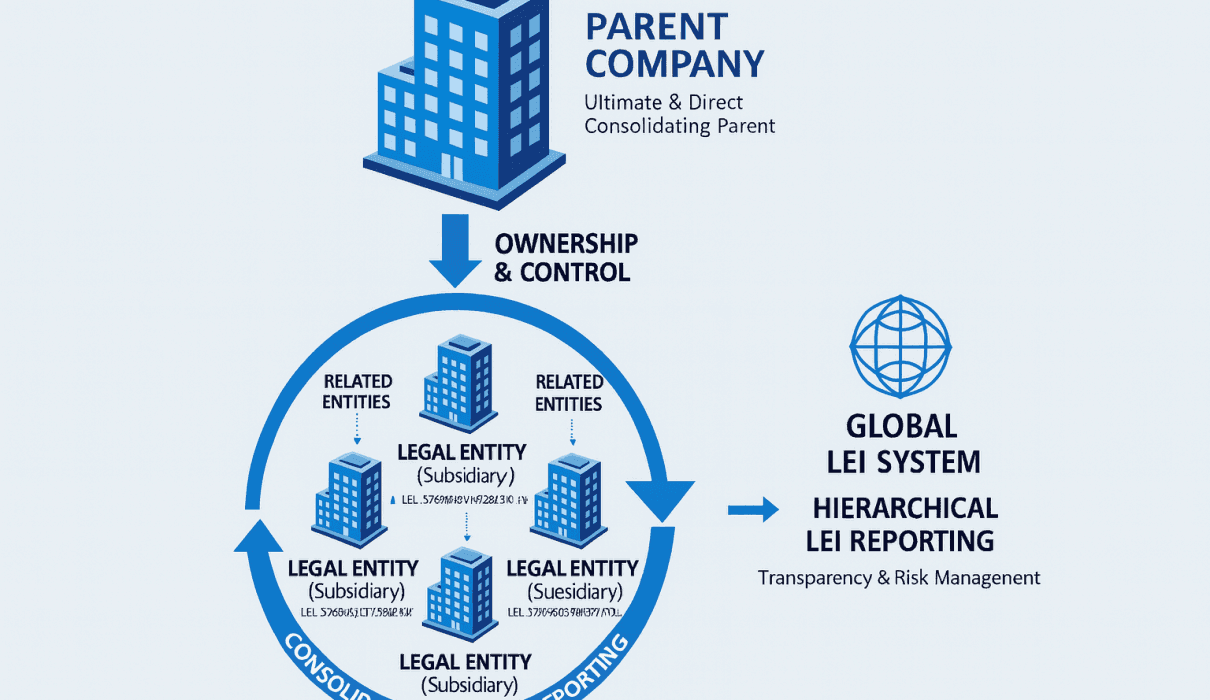
When a business applies for a Legal Entity Identifier (LEI) in the UK or internationally, it isn’t simply about verifying the existence of a company. The LEI framework goes deeper. It also captures whether the company is part of a larger group, and if so, who ultimately controls it. This requirement is known as hierarchical reporting, a system designed to bring clarity to ownership structures and reduce the risk of hidden corporate webs. At the heart of this lies the question: what is a parent company, and why does this matter in LEI reporting, especially in the UK context?
Understanding the Concept of a Parent Company
In UK terms, a parent company is an entity that either owns or controls another company, generally defined by the holding of more than 50% of the voting rights, or via significant influence over board decisions. Parent companies may be listed firms on the London Stock Exchange, holding companies established in the UK or abroad, or multinational firms operating UK subsidiaries. For example, a UK-registered subsidiary of a German multinational is required, when applying for an LEI, to disclose the European parent company as the ultimate parent. This is essential when you’re completing your LEI application or renewal for a UK entity.
Why Hierarchical Reporting Exists
The global LEI system, overseen by the Global Legal Entity Identifier Foundation (GLEIF), mandates this hierarchical or “who-owns-whom” data to ensure transparency in corporate ownership worldwide. According to the UK regulator’s guidance (via Financial Conduct Authority) on UK MiFIR transaction reporting: firms subject to reporting cannot deal with clients eligible for an LEI who do not hold one. (FCA) When parent-company relationships are disclosed, the LEI database builds a corporate family tree. This improved visibility helps UK and international banks, investors and counterparties understand “who controls whom”, which is vital for mitigation of money-laundering, fraud, and other risks.
The Two Types of Parent Relationships in LEI Reporting
When a UK legal entity applies for an LEI, it must typically disclose:
A Direct Parent: the immediate entity preparing consolidated accounts for the applicant.
An Ultimate Parent: the top-level entity in the chain that produces consolidated financial statements, even if several intermediate layers exist.
If the entity has no parent, it must declare itself as “non-consolidating”. If it cannot disclose parentage due to legal restrictions or confidentiality, it must provide a valid exception reason. For UK entities this could include where the ultimate parent is based overseas and UK law restricts publication of that detail.
Why It Matters for UK Businesses
For UK companies, hierarchical reporting is increasingly important because of regulatory frameworks and risk-assessment practices. Under UK MiFIR, firms subject to transaction reporting must ensure that their clients hold an LEI if eligible, which means identifying not only the UK entity, but the chain of ownership behind it. (FCA) For instance, if a UK subsidiary of an international group seeks financing, a UK bank assessing the risk will want to see not just the subsidiary’s financials, but also the parent company’s strength. The LEI’s hierarchical data allows the bank or counterparty to evaluate credit or operational risk with greater confidence making compliance, due diligence and cross-border dealings smoother.
How TNV LEI Simplifies the Process for UK Entities
Hierarchical reporting can feel complex because it involves more than just filling in basic company information. At TNV LEI (LEI International Pvt. Ltd.), we guide UK businesses step-by-step through the parent-company disclosures required under GLEIF. Whether your UK legal entity is part of a straightforward UK-only group, or inside a complex multinational structure, we help ensure your Level 2 data (ownership/parent relationships) is reported correctly. As a GLEIF-accredited provider, choosing TNV LEI means you apply through a partner that understands the regulatory frameworks in multiple jurisdictions and helps you navigate hierarchical data with minimal friction.
Final Word
A parent company may sound like legal jargon but in the context of LEI registration, it becomes a crucial part of building global trust. By properly disclosing your parent company or confirming there is none, your UK business strengthens transparency, aligns with regulatory expectations, and positions itself better in the global financial ecosystem. If your UK business needs to apply for or renew an LEI, make sure your hierarchical data is accurately reported. Visit tnvlei.com and let TNV LEI help streamline the process.