

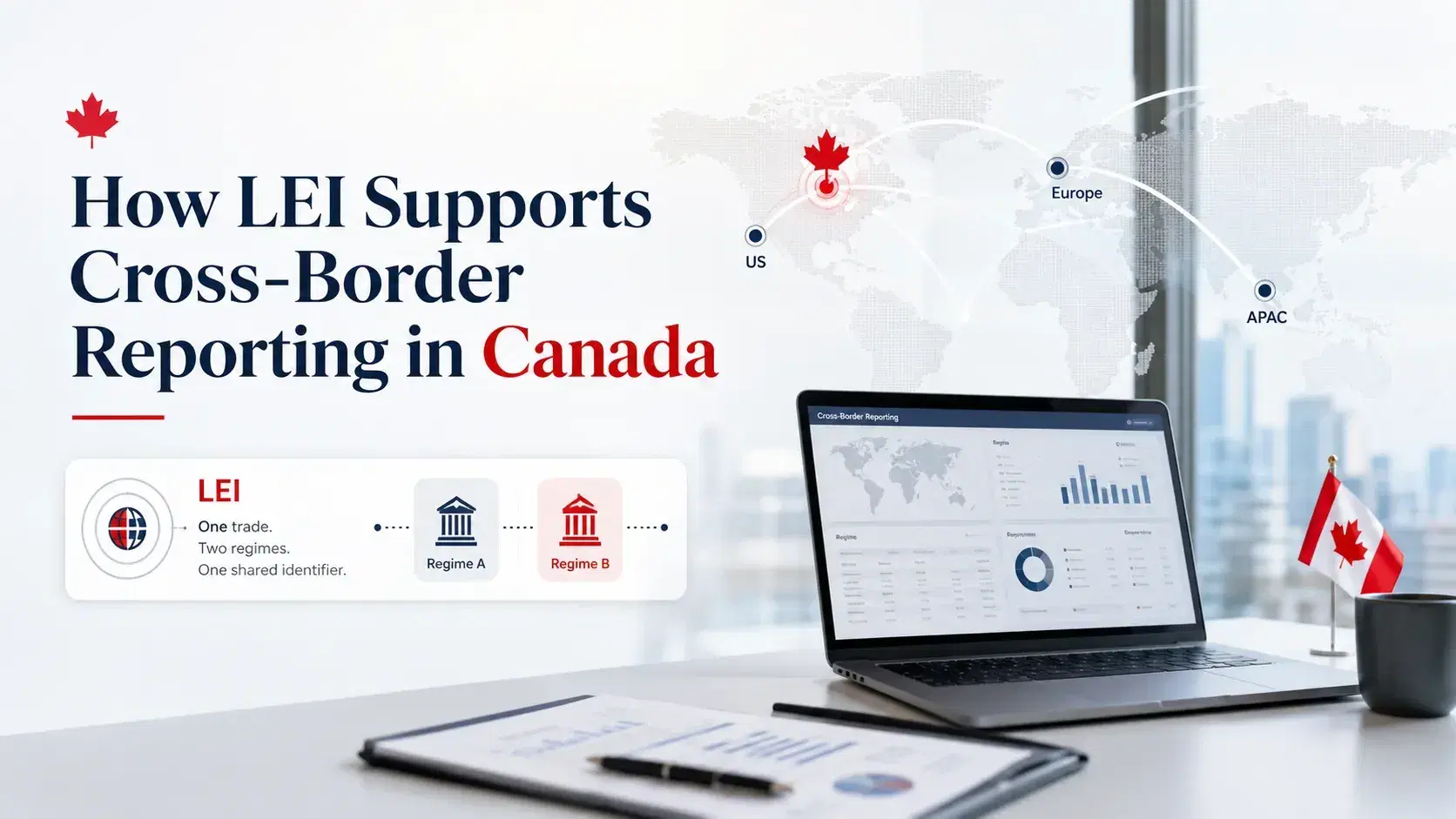
One trade, two regimes
A Canada entity facing an overseas counterparty often appears in two reports: its own under CSA Multilateral Instrument 96-101, and the counterparty's under their regime. Without a common identifier, reconciling those two views would be impossible.
How the LEI ties them together
The 20-character LEI is global and permanent. The same code the Canadian Securities Administrators (CSA) sees on a Canada report is the code an EU, US or APAC counterparty reports on the other side. That shared identity is the whole point of the LEI.
What this means in Canada
For a Canada entity, the practical rule is simple: keep your LEI current and accurate. A lapsed LEI breaks not only your DTCC Data Repository (US) LLC and ICE Trade report but potentially your counterparty's foreign report too, putting the trade at risk.
Getting it right
Confirm your LEI status before cross-border trades, renew on time, and keep reference data aligned with the federal and provincial corporate registries.
Key takeaways
• A cross-border trade can be reported under two regimes.
• The LEI is the shared identifier across both.
• A lapsed LEI can fail reports on both sides.
• Keep it current to keep cross-border flows clean.
