

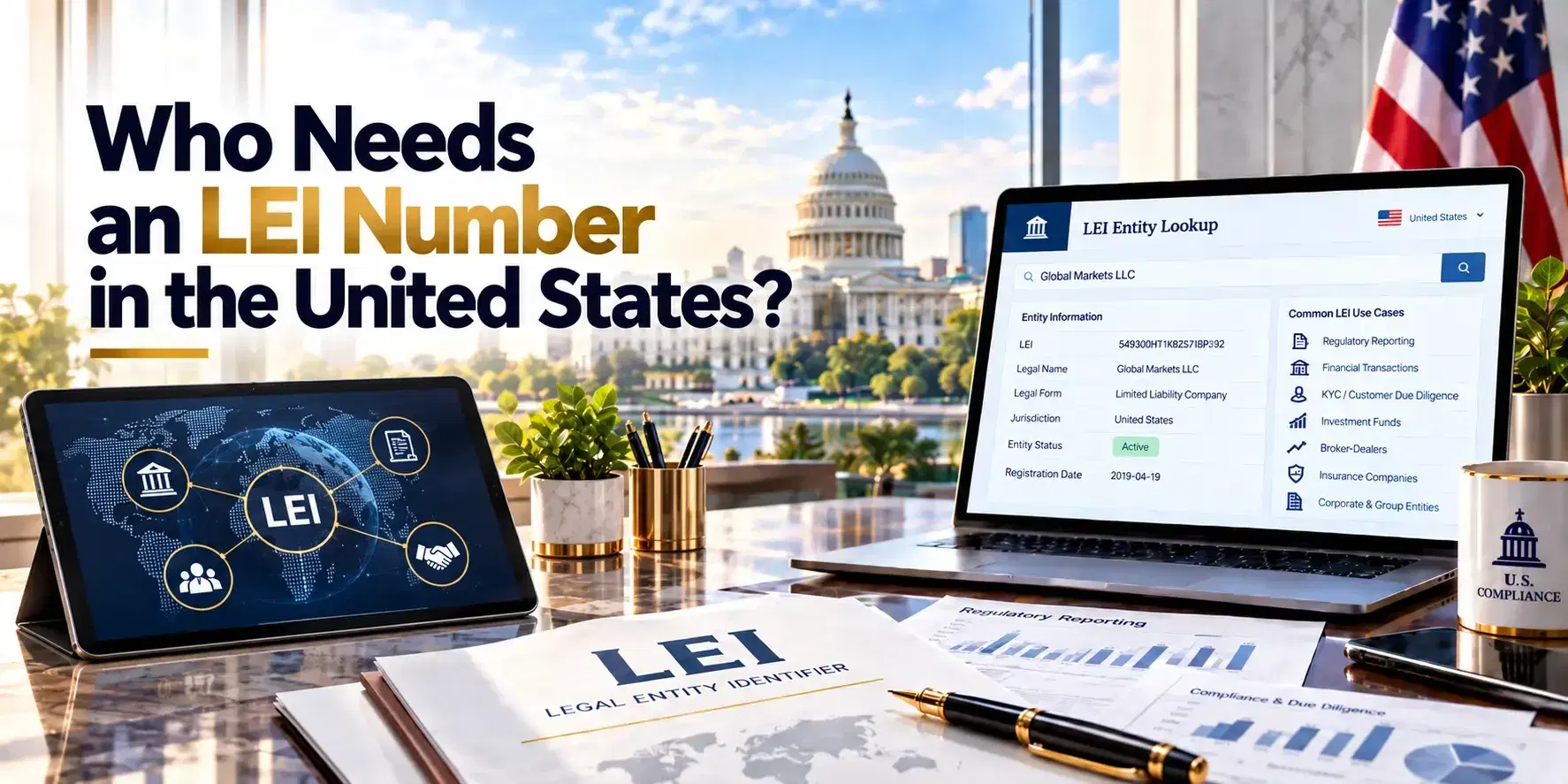
There is no single U.S. law that obliges every company to hold one. An LEI becomes necessary when a specific rule, a reporting regime, or a counterparty requires it - and the list of organizations for which one of those three now applies keeps getting longer.
That is the obligation side. There is a second reason firms register before anyone asks: an LEI is the one identifier a counterparty can verify about you without a phone call. Where an onboarding team, a bank or a trading platform has to confirm who your entity is, having a live record already published shortens that conversation - and holding one in advance means a mandate that arrives at short notice does not hold up a transaction.
This guide covers exactly who needs an LEI number in the United States, which rules create the obligation, and how to tell whether yours is one of them.
If you are new to the identifier itself, start with our guide to what is an LEI number.
Quick Answer: You Need an LEI If You
- trade swaps or derivatives that are reported to a U.S. trade repository
- are a party to security-based swaps reported under SEC rules
- are a private fund adviser filing the amended Form PF
- are a registered investment company filing Form N-CEN or N-PORT
- are onboarded with DTCC for clearing and settlement
- trade with, or through, an EU counterparty subject to MiFID II or EMIR
- have a bank, broker, custodian, or platform asking for one during onboarding
Each of these is explained below, with the rule it comes from.
Where an LEI Number Is Required Under United States Rules
Swaps and Derivatives - CFTC, 17 CFR 45.6
This is the clearest LEI mandate in U.S. law, and the regulation is named for it: 17 CFR 45.6, "Legal entity identifiers."
The rule requires swap execution facilities, designated contract markets, derivatives clearing organizations, swap data repositories, and reporting entities to obtain, maintain, and be identified by a single LEI. It then extends the obligation outward: any counterparty to a swap that is eligible to receive an LEI must obtain one and use it for all recordkeeping and swap data reporting under Part 45.
There is a detail here that catches businesses out. Financial entity reporting counterparties must make best efforts to cause an LEI to be assigned to a counterparty that does not have one, before reporting swap creation data. In practice, that means if your bank or dealer is the reporting party on a swap, they have a regulatory reason to chase you for an LEI - and if they cannot get one assigned, they must report your identity and contact details to the Commission.
So if your organization trades swaps at all, even occasionally and even as the non-reporting side, you are in scope.
Security-Based Swaps - SEC Regulation SBSR
Regulation SBSR governs the reporting and public dissemination of security-based swap information. Counterparties to security-based swaps are identified in that reporting using unique identification codes, and the LEI is the identifier used for legal entities in that system.
If your organization is a party to security-based swaps, an LEI is part of how you are identified in the reported data.
Private Fund Advisers - SEC Form PF
The amendments to Form PF require reporting advisers to identify themselves and related entities using LEIs.
The compliance date for those amendments is now 1 July 2027. The SEC and CFTC extended it from 1 October 2026 on 31 August 2026, to allow time to evaluate comments on an April 2026 proposal that would modify or eliminate parts of the amendments. This date has moved four times, so confirm it before planning around it.
If you advise private funds and file Form PF, the direction is settled even if the date is not: you will need LEIs in place for the adviser and the entities the filing covers.
Registered Funds - Form N-CEN and Form N-PORT
Form N-CEN requires an LEI for the registrant itself and for each series or fund being reported. For service providers - underwriters, auditors, advisers, transfer agents, custodians and brokers - the form asks for the "LEI, if any."
That distinction matters. For the fund and its series, the LEI is required. For service providers, it is collected where one exists - so having an LEI means your fund clients can complete their filings using your identifier rather than a substitute.
Banks and QFC Recordkeeping - 12 CFR Part 371
The FDIC's recordkeeping requirements for qualified financial contracts take a conditional approach. Records entities provide their LEI "if available," and for counterparties the rule states the identifier "shall be the global legal entity identifier if one has been issued to the entity," with substitutes permitted where no LEI exists.
This is a good example of a rule that does not force you to obtain an LEI - but that works more smoothly if you have one. If your organization is a counterparty to qualified financial contracts with a covered U.S. bank, expect the LEI question during onboarding.
Clearing and Settlement - DTCC
DTCC's clearing subsidiaries - DTC, NSCC and FICC - filed rule changes with the SEC in 2025 to require LEIs for participants. The filings are SR-DTC-2025-009, SR-NSCC-2025-009 and SR-FICC-2025-012, and they became effective on 25 April 2025.
New applicants - Participants, Pledgees, DRS Agents, FAST Agents and equivalent roles at each subsidiary - must provide an LEI as part of their application. Existing members who do not yet have one on file must obtain and submit an LEI within 60 calendar days of being notified through a DTCC Important Notice. The requirement is ongoing rather than one-off: an LEI that is not renewed within its one-year cycle lapses, and a lapsed record is not a maintained one.
Cross-Border - EU Rules That Reach U.S. Entities
A U.S. company can be pulled into an LEI requirement by a foreign rule rather than a domestic one.
Under the MiFID II/MiFIR regime, Article 13 of RTS 22 (Commission Delegated Regulation (EU) 2017/590) states it plainly: "An investment firm shall not provide a service triggering the obligation to submit a transaction report for a transaction entered into on behalf of a client who is eligible for the legal entity identifier code, prior to obtaining the legal entity identifier code from that client." Article 7(2) of the same regulation specifies that the LEI is the identifier used for legal entity clients in those transaction reports. Under EMIR, derivative contracts reported in the EU identify counterparties by LEI. Neither rule is U.S. law, but both bite on U.S. organizations that trade through European firms or face European counterparties.
This catches exporters, U.S. subsidiaries of European groups, and any American business investing through an EU broker.
On the Horizon - The Financial Data Transparency Act
The FDTA joint data standards final rule, which takes effect on 1 October 2026, establishes the LEI as the common identifier for legal entities across nine U.S. financial regulators.
Read the nuance carefully: the joint rule does not create an immediate, universal LEI requirement for every U.S. company. It sets the standard. Each agency then applies it through its own rulemaking, and the scope and timing will vary. But the direction is settled, and the identifier chosen is the LEI.
Who Typically Needs an LEI, by Organization Type
Grouping the rules above by who they land on:
- Banks, credit unions and broker-dealers - swap reporting, QFC recordkeeping, DTCC onboarding
- Swap dealers and major swap participants - directly named in CFTC Part 45
- Private fund advisers - Form PF
- Registered investment companies and their service providers - Forms N-CEN and N-PORT
- Asset managers, hedge funds and private equity funds - fund-level reporting and counterparty onboarding (see the FAQ below on where fund LEIs are issued)
- Insurers and pension administrators - investment activity and counterparty requirements
- SPVs and holding companies - usually because a lender, counterparty or parent's reporting requires it
- Corporates and exporters trading internationally - MiFID II and EMIR exposure through EU counterparties
- Fintechs and payment institutions - increasingly, as payment messaging standards adopt entity identifiers
Who Does Not Need an LEI
It is worth being equally clear about the other side.
You almost certainly do not need an LEI if your business does not take part in financial-market activity - no swaps or derivatives, no securities trading, no regulated financial filings, no EU counterparties, and no bank or platform asking for one. A domestic small business, a local service company, or a sole proprietorship operating only in the U.S. generally has no LEI obligation.
An LEI also does not replace anything you already hold. It is not a tax ID and not a state registration number - those identify you for different purposes and are issued by different authorities.
And an LEI identifies a legal entity, not a person acting in a private capacity. Individual retail investors generally do not need one, although individuals acting in a business capacity may qualify in some cases.
A Simple Way to Decide
Work through these in order:
- Do you trade swaps, derivatives or security-based swaps? If yes, you need an LEI.
- Do you file Form PF, N-CEN or N-PORT? If yes, you need an LEI.
- Are you onboarded with DTCC? If yes, you need an LEI.
- Do you trade with or through an EU firm? If yes, you will be asked for one and may be unable to trade without it.
- Has a bank, broker, custodian or platform asked you for one? If yes, that is your answer regardless of what any rule says.
- None of the above? You probably do not need one today. Keep an eye on FDTA implementation in your sector.
Check Whether Your Organization Already Has One
Many U.S. entities already hold an LEI without realizing it - obtained years ago for a single trade, by a parent company, or by a bank acting on their behalf. Those records lapse quietly when nobody renews them.
Before registering, search for your LEI by legal name. If a record exists, check its status and next renewal date. A lapsed record still identifies you, but many counterparties and reporting processes will not accept it - an LEI renewal restores it, and the 20-character code never changes.
If no record exists and one of the triggers above applies, you can register an LEI number directly with TNV LEI. As a GLEIF-accredited Local Operating Unit, we issue official LEIs recognized throughout the Global LEI System.